
 Printables
 Scavenger hunt
Element scavenger hunt: a printable checklist for home or class
Twelve everyday things to find, each with its element, its symbol and the true fact behind it. One list for home, one for the classroom. Kids tick a box and say the element's name out loud, and five minutes later they've said aluminum, copper and carbon about a dozen times without noticing.
How do you run an element scavenger hunt?
- Print one list per kid or per pair. Pairs work better in a classroom: one finds, one ticks.
- Set a timer for five minutes (ten at home, where things are spread across rooms).
- Say it out loud. The rule is that a find only counts if the finder says the element's name. That's the part that teaches.
- Go through the list together at the end. Read the "why it counts" line for anything that surprised them. Most kids don't expect sand and glass to be the same two elements.
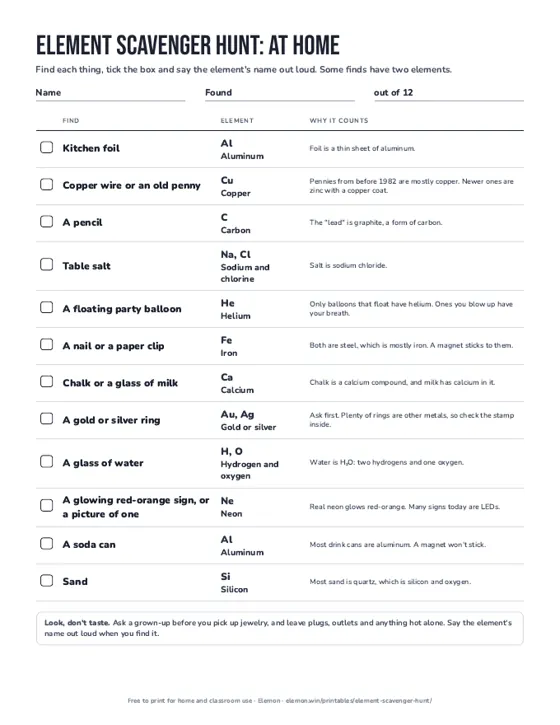
The home list
| Find | Element | Why it counts |
|---|---|---|
| Kitchen foil | Al Aluminum | Foil is a thin sheet of aluminum. |
| Copper wire or an old penny | Cu Copper | Pennies from before 1982 are mostly copper. Newer ones are zinc with a copper coat. |
| A pencil | C Carbon | The "lead" is graphite, a form of carbon. |
| Table salt | Na, Cl Sodium and chlorine | Salt is sodium chloride. |
| A floating party balloon | He Helium | Only balloons that float have helium. Ones you blow up have your breath. |
| A nail or a paper clip | Fe Iron | Both are steel, which is mostly iron. A magnet sticks to them. |
| Chalk or a glass of milk | Ca Calcium | Chalk is a calcium compound, and milk has calcium in it. |
| A gold or silver ring | Au, Ag Gold or silver | Ask first. Plenty of rings are other metals, so check the stamp inside. |
| A glass of water | H, O Hydrogen and oxygen | Water is H₂O: two hydrogens and one oxygen. |
| A glowing red-orange sign, or a picture of one | Ne Neon | Real neon glows red-orange. Many signs today are LEDs. |
| A soda can | Al Aluminum | Most drink cans are aluminum. A magnet won't stick. |
| Sand | Si Silicon | Most sand is quartz, which is silicon and oxygen. |
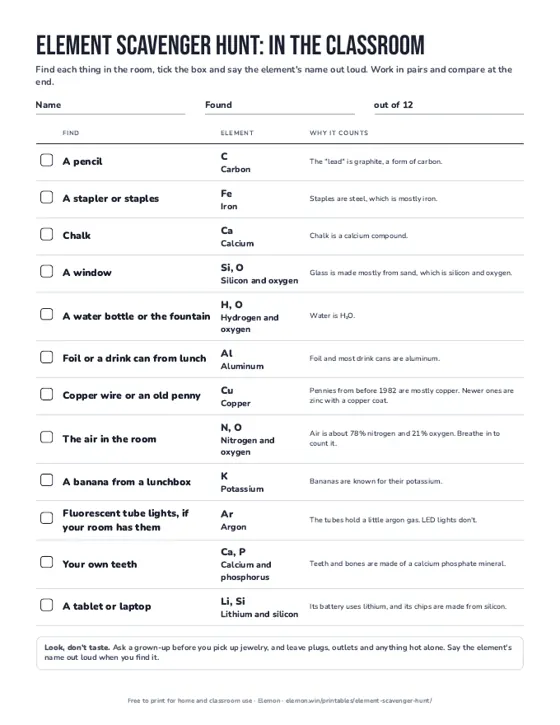
The classroom list
The classroom version drops salt and balloons and adds things every room has, like the window and the stapler.
| Find | Element | Why it counts |
|---|---|---|
| A pencil | C Carbon | The "lead" is graphite, a form of carbon. |
| A stapler or staples | Fe Iron | Staples are steel, which is mostly iron. |
| Chalk | Ca Calcium | Chalk is a calcium compound. |
| A window | Si, O Silicon and oxygen | Glass is made mostly from sand, which is silicon and oxygen. |
| A water bottle or the fountain | H, O Hydrogen and oxygen | Water is H₂O. |
| Foil or a drink can from lunch | Al Aluminum | Foil and most drink cans are aluminum. |
| Copper wire or an old penny | Cu Copper | Pennies from before 1982 are mostly copper. Newer ones are zinc with a copper coat. |
| The air in the room | N, O Nitrogen and oxygen | Air is about 78% nitrogen and 21% oxygen. Breathe in to count it. |
| A banana from a lunchbox | K Potassium | Bananas are known for their potassium. |
| Fluorescent tube lights, if your room has them | Ar Argon | The tubes hold a little argon gas. LED lights don't. |
| Your own teeth | Ca, P Calcium and phosphorus | Teeth and bones are made of a calcium phosphate mineral. |
| A tablet or laptop | Li, Si Lithium and silicon | Its battery uses lithium, and its chips are made from silicon. |
A few things to know before you start
- Look, don't taste. Nothing on the list needs to be eaten, opened or taken apart.
- Leave plugs and outlets alone. Copper wire counts if you can see it on a spool or in a science kit, not inside the wall.
- Pennies are tricky. Ones from before 1982 are mostly copper. Newer ones are zinc with a copper coat, which is why the list says "copper wire or an old penny."
- Not every shiny thing is what it looks like. Paper clips and nails are steel, which is mostly iron. Plenty of rings are steel or other metals, so check the stamp inside or ask.
Frequently asked questions
How long does an element scavenger hunt take?
About ten to fifteen minutes at home. In a classroom, give pairs five minutes, then spend five more going through what they found and why it counts.
What age is the element scavenger hunt for?
Ages 6 to 10 is the sweet spot. Younger kids can hunt with a grown-up reading the list, and older kids can add the symbol next to each find from memory.
Is a penny really copper?
Partly. US pennies from before 1982 are about 95% copper. Newer ones are zinc with a thin copper coat, so copper is still what you see. Copper wire is copper all the way through.
What if we can't find something on the list?
Skip it, or find a picture of it in a book or online. A real neon sign is hard to come by, and plenty of rings are steel or other metals. The point is saying the element's name, not finding every item.
More to print: element matching cards with a find-it picture for each element, periodic table bingo, and the element cards 1 to 20. The hunt is one of eight easy games to teach kids the element names.
Found them all? Meet each one as a monster in the Elemondex, or play a match.