
 Printables
Learn Printables

Free printable element cards: the first 20 elements
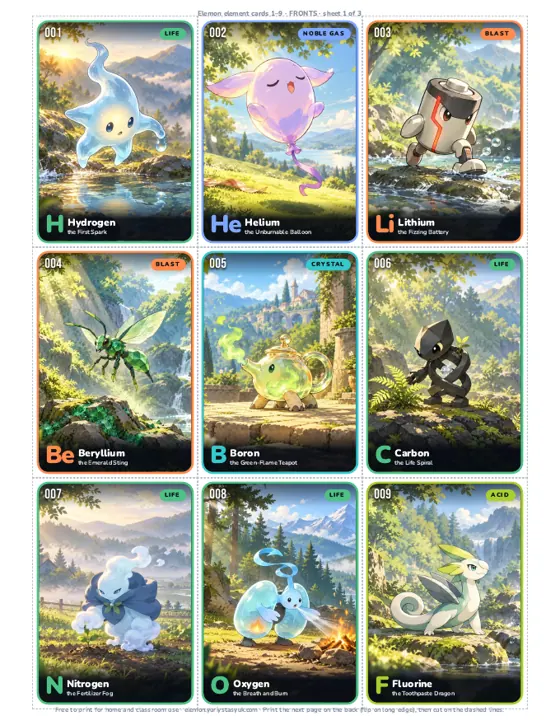
Twenty printable element cards, hydrogen to calcium, with Elemon's monster art on the front and the real science on the back. They're free to print for home and classroom use, in US Letter and A4.
What's on each element card?
Every card matches its card in the online game, so kids can move between the table and the screen.
- Front: the element as an Elemon monster, its atomic number, its symbol, its name and nickname (sodium is "the Salt Lamp"), and its battle type.
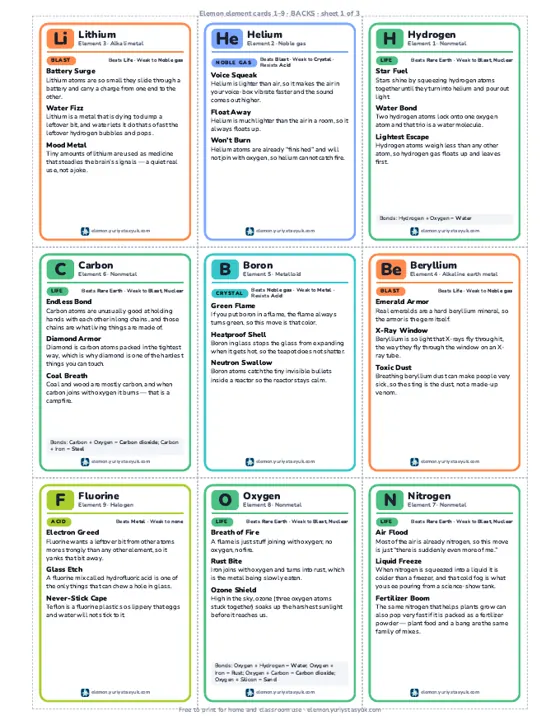
- Back: the element's real family (alkali metal, noble gas and so on), which type it beats and which it's weak to, its three moves with the true fact behind each one, and its bond buddies, the elements it joins with in real chemistry.
The set covers the first 20 elements, the same twenty most science classes start with:
How do you print and cut the cards?
- Pick your paper size: US Letter or A4. Use card stock if you can.
- Print double-sided, flipping on the long edge, at 100% scale. The PDF goes front, back, front, back, and each back sheet is mirrored so it lines up with its front.
- Cut on the dashed lines. Each sheet holds nine 2.5 × 3.5 inch cards, the same size as standard trading cards, so card sleeves fit.
- No duplex printer? Print the fronts, flip the stack, and print the backs. Or print both sides on separate sheets and glue them together before cutting.
What games can kids play with printable element cards?
You don't need a screen for any of these. Each one takes a minute to explain.
Atomic War (2 players)
Deal the cards face down. Both players flip one card at the same time, and the higher atomic number wins both. It sounds simple, but after a few rounds kids know that calcium beats potassium without looking.
Sort by type (1 or more players)
Sort all 20 cards by Elemon type: the first 20 cover six of the nine (Blast, Life, Acid, Noble gas, Crystal and Metal). Then sort them again by real family, or into metals, metalloids and nonmetals, and talk about what changed. The types and families guide has the answers.
Match the bond (2 to 4 players)
Spread the cards face up and race to find pairs that make something real: hydrogen and oxygen make water, sodium and chlorine make table salt, carbon and oxygen make carbon dioxide, silicon and oxygen make sand, and calcium and phosphorus make the mineral in bones. The backs of the cards list each element's bonds.
Build the table (1 or more players)
Lay the cards out in the shape of the real periodic table: hydrogen and helium on row 1, lithium to neon on row 2, sodium to argon on row 3, then potassium and calcium to start row 4.
How does the design-your-own card sheet work?
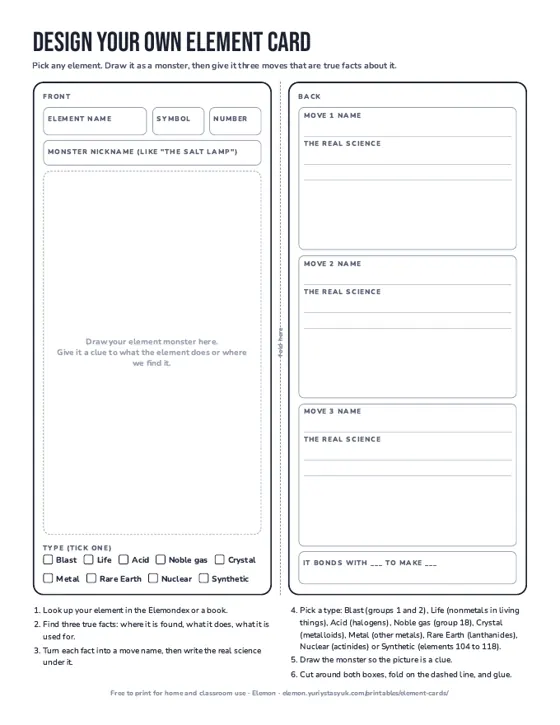
The worksheet has a blank front and back side by side. Kids pick any element, look it up, turn three true facts into move names, write the real science under each one, and draw the element as a monster whose look is a clue to what it does. Then they cut it out, fold it in half and glue it into a two-sided card. It works well as a homework project or an exit activity, and it pushes kids to research one element properly.
Can teachers use these cards in class?
Yes. The cards and worksheet are free to print for home and classroom use, so make as many copies as your class needs. For a full lesson built around them, see the teacher's guide with a 45-minute lesson plan. For a quick whole-class review, try periodic table bingo with the same 20 elements.
Frequently asked questions
Are these element cards really free?
Yes. They're free to print for home and classroom use. There's no sign-up and no email needed. Just download the PDF.
What paper should I print the cards on?
Card stock (about 65 lb / 176 gsm or heavier) holds up best, but plain paper works for a single lesson. Print at 100% or “actual size” so the cards come out 2.5 × 3.5 inches.
How do I print the cards double-sided?
Print the whole PDF double-sided and choose “flip on long edge.” The backs are already mirrored so each back lines up with its front. No duplex printer? Print the odd pages, put the stack back in the tray, then print the even pages.
Which elements are included?
The first 20, hydrogen to calcium: Hydrogen, Helium, Lithium, Beryllium, Boron, Carbon, Nitrogen, Oxygen, Fluorine, Neon, Sodium, Magnesium, Aluminum, Silicon, Phosphorus, Sulfur, Chlorine, Argon, Potassium, Calcium.
Do you have cards for all 118 elements?
Every element has a card you can browse online in the Elemondex, and all 118 are playable in the game. The printable set covers the first 20 for now, because that's the set most classes start with.
Want to see the cards in action? Start a match online, or browse all 118 cards in the Elemondex.