
 Learn
How do you teach elementary kids the names of the elements?
 Helium#2 Noble gas type
- Found by locking at the Sun’s light — helium was seen in space first.
- It will not burn, so party balloons use it instead of hydrogen.
- Keeps giant magnets and lab machines very cold.
Teach elementary kids the element names, the first words of chemistry, the way they learn any new names: a few at a time, attached to things they can see or touch, and repeated in play. Start with about a dozen everyday elements in first and second grade. Add the first 20 and their symbols in grades 3 to 5. Leave the order of the table for middle school. Ten minutes a few times a week is enough.
On this page


This page is for classroom teachers, homeschool parents running a small group, and anyone with kids in first to fifth grade. Teaching your own child at home? The parent version is how to teach kids the periodic table.
A word before you start. If you're reaching for a full periodic table poster and a test on all 118, put it down. That plan is for you, not for a seven-year-old. Kids this age need a few names they can say, attached to things they can hold. Everything below is built on that.
Aim small
Elementary kids need less than most adults expect. In the standards I checked, the periodic table itself is a middle school topic. NGSS asks fifth graders to model matter as particles too small to see, and Virginia's framework says students meet the atom in fifth grade and the periodic table later, in Physical Science. The grade-by-grade details are in what grade kids learn the periodic table.
So an elementary goal can be small and still useful:
- Kids know that everything is made of elements, and that there are 118 of them.
- They can name 10 to 20 elements and say one true thing about each.
- Older kids can match some of those names to their symbols.
Names come first because they're words kids can say and recognize. Symbols are easier once the name is familiar, and the order of the table means very little until a kid knows what's in it.
Ages 6 and 7: names they can point to
Pick elements a six-year-old can find in the room or picture easily: helium in a balloon, oxygen in the air, the sodium and chlorine in table salt, aluminum foil, iron in a nail, gold in a ring, neon in a glowing sign. Our list of everyday elements for kids has twelve, each with where kids meet it.
Say the names aloud and skip the spelling. Many first graders can't read "chlorine" yet, and they don't need to. Read the card or the fact to them, let them repeat the name, and ask them to point to the thing it's in. A kid who says "helium makes balloons float" has learned the name.
Two or three new names a sitting. Come back to the old ones every time. That's the rule.
Ages 8 to 10: the first 20 and their symbols
Grades three to five can work toward the first 20 elements, hydrogen to calcium, plus a few famous metals: iron, copper, silver and gold. That set appears again and again in school materials. The Royal Society of Chemistry's periodic table bingo uses the first 20 plus those four metals, and its notes say most curricula expect students to know the first 20.
This is also a good age for symbols. Most are the first letter or two of the name (H for hydrogen, Ne for neon), which kids pick up quickly. A few don't match at all, like Na for sodium and Au for gold. Kids at this age tend to like the stories behind those odd symbols, so teach them as stories rather than exceptions to drill. Our guide to why gold is Au has all eleven.
The first 20 elements for kids page has the full list with a fact for each, and you can project or print it.
The 10-minute routine
Run the same short routine two or three times a week. Kids remember names they meet often. They forget names they crammed once.
- Reveal, 2 minutes. Show one new element card with the name covered. Read its fact or move, and let kids guess what it might be. Then show the name and say it together.
- Connect, 2 minutes. Ask where they've seen it. Write the name next to the real object on the board: "neon: glowing signs."
- Play, 5 minutes. Run one of the games below, using the new names mixed with old ones.
- Check, 1 minute. Ask one question as kids line up or pack up: "Which element is in a balloon?"
At four or five new names a week, a class reaches the first 20 in about a month. If you want each week planned out, the 4-week homeschool unit lays out the same ground one week at a time.
What are easy games to teach kids the element names?
The easiest way to teach kids the element names is to play with them: match a name to its symbol and to something real, call names in bingo, and hunt for elements around the house. Each game below takes five to fifteen minutes and needs paper, a printer or things you already own.
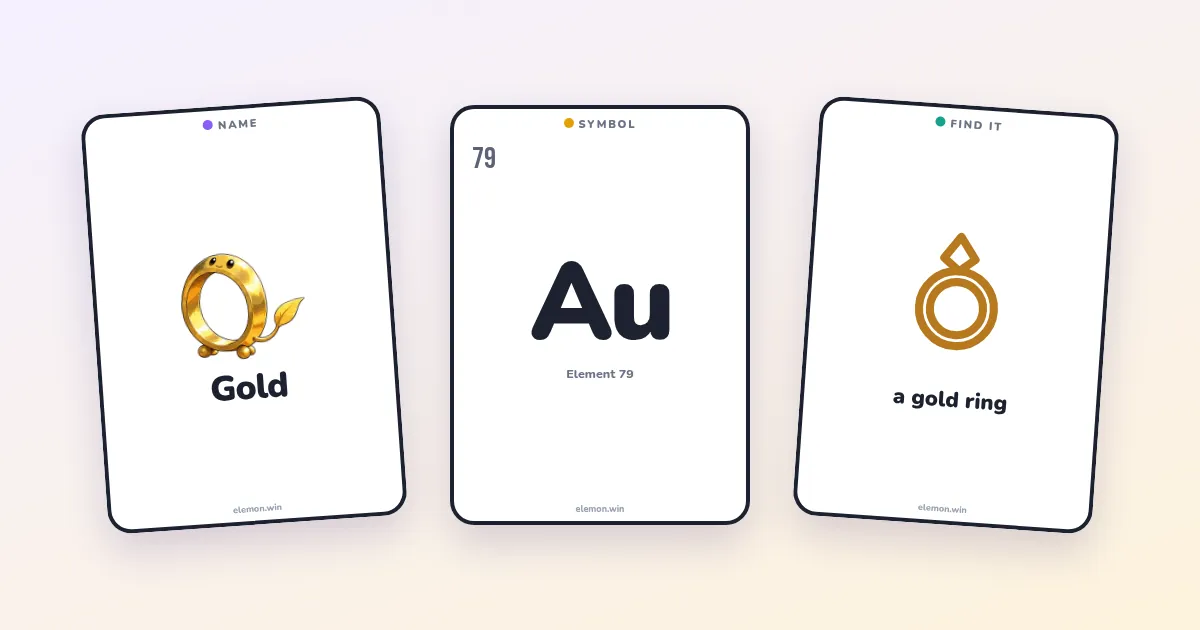
- Element memory match. Make three cards for each element, one with the name, one with the symbol and one with a picture of where you find it, like Gold, Au and a gold ring. Lay them face down and flip two (or three for older kids); a match is yours to keep. Printable matching cards
- Element bingo. Call out "nitrogen" and kids cover N on their card. For little ones, call the symbol or a clue like "I make balloons float" instead. Periodic table bingo cards and caller
- Household element scavenger hunt. Give kids a short list and five minutes: aluminum foil, copper wire or an old penny, a pencil (graphite is carbon), table salt (sodium and chlorine), a party balloon (helium). They say the element's name out loud when they find it. There's a classroom list too. Printable hunt list
- Spell your name in element symbols. Kids try to write their name using only symbols: Nico is Ni + Co, and Lucas is Lu + Ca + S. A name with a J or a Q can't be done, because no symbol uses those letters, and kids love finding that out. My son Ares spells his as Ar + Es, argon and einsteinium.
- Element Go Fish. Use the name and symbol cards from the matching game and ask "Do you have Fe?" or "Do you have sodium?" to make pairs. It drills the odd symbols (Na, K, Fe, Au), because those are the ones kids ask about.
- Odd-symbol detective. Show Au, Fe and Na and ask kids to guess the element. Then tell the story: Au comes from aurum, the Latin word for gold. One story a week is plenty. Why gold is Au
- Card at the door (speed symbols). Hold up one element card as each kid walks in. They say the name, or the symbol for older kids, before sitting down. Time the whole stack once a week and try to beat it.
- An element card battle. Kids who like monster card games can play Elemon in a browser, where every card is a real element and every move is a true fact about it, so they hear names like chlorine and argon again and again while trying to win. Younger kids can play on Easy with someone reading the move facts aloud.
Printed element cards for 1 to 20 also work for the door game and Go Fish.
For a fifth-grade class
Fifth graders can carry more. Aim for the first 20 names with their symbols, play periodic table bingo on the symbol side, and hand out the printable element cards for a sorting game: metals in one pile, gases in another. Leave reading the rows and columns for sixth grade.
Checking what stuck
Turn the facts around. Instead of "What is helium?", give the fact and ask for the name: "Which element makes balloons float?" Kids who can answer that know the name and what it means, which is the goal.
For a quick written check in grades three to five:
- Write the names of three elements you know, and one place you find each.
- Match five names to their symbols.
- Pick one element and tell a friend something true about it.
And don't grade spelling for the younger group. A kid who writes "neeon" and knows it glows has learned exactly what you were teaching.
What about memorizing the whole table?
Don't. Kids this age don't need the order of all 118, and reciting the order won't tell them what any element is. If your class or a challenge does call for memorizing, the methods in how to memorize the periodic table work best once kids already know a handful of names.
Songs are fine as a bonus. They're good at order and rhythm. Pair them with cards or a game so the names come with meaning.
What about chemistry names like sodium chloride?
Sooner or later a kid reads the salt box. It says sodium chloride, and they want to know why salt has two names.
It's two element names joined together. Sodium keeps its name. Chlorine changes its ending to -ide, so it becomes chloride. Water would be hydrogen oxide if anyone called it that. That's as far as elementary school needs to go. Formulas like NaCl and H₂O can wait for middle school, and elements and compounds for kids explains the joining part in plain words.
Frequently asked questions
Do 5th graders learn the periodic table?
Usually not as a full topic. In the standards I checked, fifth grade covers matter as tiny particles, and the periodic table comes in middle school. Many fifth graders are ready for the first 20 names and symbols, so it's a good stretch for a class that's curious. See what grade kids learn the periodic table.
How many element names should a 7-year-old know?
There's no standard for it. A handful they can say and connect to real things is a good start, around 10 to 12. Some kids will want many more, and that's fine.
When should kids learn element symbols?
Once the names are familiar, usually around grades three to five. Start with symbols that match the name, like H and O, and save the odd ones (Na, K, Fe, Au) for stories.
Can kids who can't read yet learn element names?
Yes. Say the names aloud, show the object, and let them repeat. Reading can come later.
Pick your first three names tonight. Helium, oxygen and gold is a fine start.