
 Printables
 Matching cards
Element matching cards: name, symbol and where you find it
Three cards for each of 24 elements: the name with its Elemon monster, the symbol with its atomic number, and a picture of something real that has it in it. Gold, Au and a gold ring. Helium, He and a balloon. Kids flip them face down and play memory match or Go Fish, and the names stick because they come with a thing to picture.
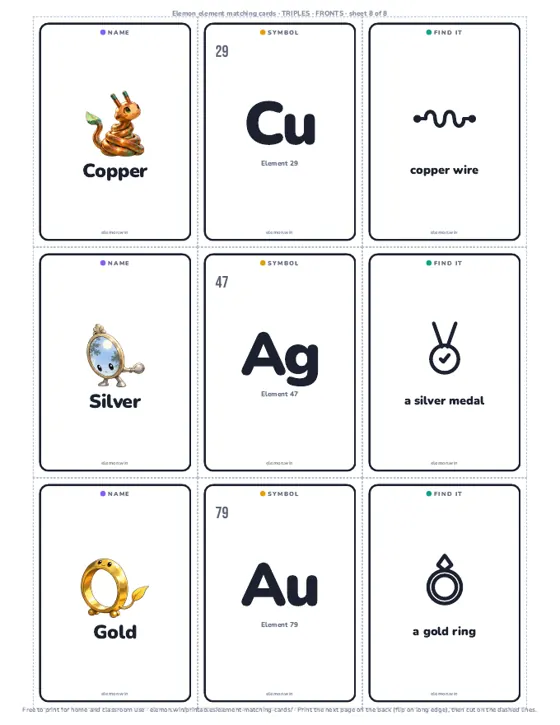
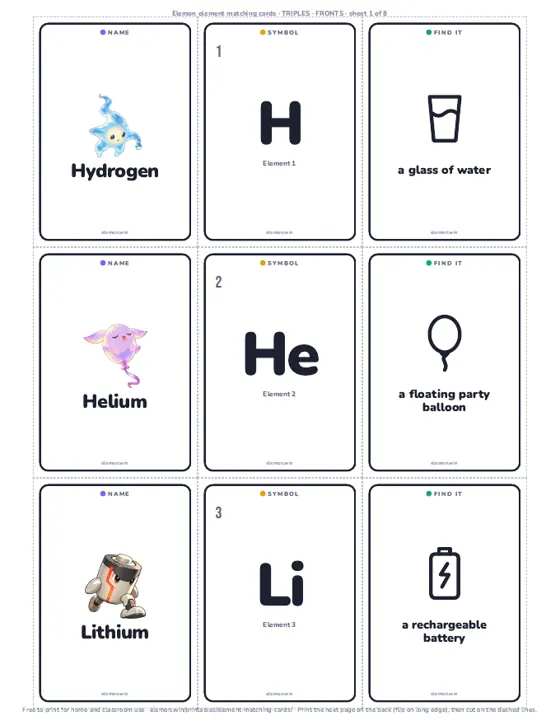
How do you play element memory match?
- Pick your set. Pairs (name and symbol) for a first game, triples once kids know a few. Start with 8 to 10 elements, not all 24. A short game that ends in a win beats a long one that ends in tears.
- Shuffle and lay the cards face down in a grid.
- Take turns flipping two cards, or three in the triples game, and say each one out loud: "Gold. Au." If they belong to the same element, keep them and go again. If not, turn them back over.
- The player with the most sets wins. Then ask the winner to pick one set and say where you'd find that element.
For a gentler start, play it face up: spread out all three cards for six elements and race to sort them into sets.
Go Fish with element cards
- Deal five cards each from the pairs set and put the rest in a pile.
- Ask for the other half of a pair you hold: "Do you have Fe?" or "Do you have sodium?" If they do, they hand it over. If not, "Go fish," and you draw.
- Lay down each pair you make and read it out. Most pairs wins when the pile runs out.
The odd symbols come up fast in Go Fish, because kids holding Na have to ask for sodium and someone always says "that's not an S." The story behind each one is in why gold is Au.
Which elements are in the set?
The first 20, hydrogen to calcium, plus iron, copper, silver and gold. Each find-it card shows something a kid can actually see or hold.
| # | Symbol | Name | Find-it card |
|---|---|---|---|
| 1 | H | Hydrogen | a glass of water |
| 2 | He | Helium | a floating party balloon |
| 3 | Li | Lithium | a rechargeable battery |
| 4 | Be | Beryllium | an emerald |
| 5 | B | Boron | borax cleaning powder |
| 6 | C | Carbon | a pencil |
| 7 | N | Nitrogen | the air around you |
| 8 | O | Oxygen | what a fire needs |
| 9 | F | Fluorine | fluoride toothpaste |
| 10 | Ne | Neon | a glowing red-orange sign |
| 11 | Na | Sodium | table salt |
| 12 | Mg | Magnesium | green leaves |
| 13 | Al | Aluminum | kitchen foil |
| 14 | Si | Silicon | sand |
| 15 | P | Phosphorus | a matchbox striker |
| 16 | S | Sulfur | a boiled egg's smell |
| 17 | Cl | Chlorine | a swimming pool |
| 18 | Ar | Argon | an old-style light bulb |
| 19 | K | Potassium | a banana |
| 20 | Ca | Calcium | milk |
| 26 | Fe | Iron | an iron nail |
| 29 | Cu | Copper | copper wire |
| 47 | Ag | Silver | a silver medal |
| 79 | Au | Gold | a gold ring |
How do you print and cut them?
- Print double-sided at 100% scale, flipping on the long edge. Fronts and backs alternate in the PDF.
- Cut on the dashed lines. Nine cards a sheet, each 2.5 × 3.5 inches, so trading card sleeves fit.
- Keep sets apart with a rubber band per game: a beginner pack of eight elements, then the rest.
Frequently asked questions
What age are the element matching cards for?
Pairs (name and symbol) work from about age 7, once a kid can read short words. Younger kids do better with the find-it cards, because they can match a picture of a balloon to the word helium with a grown-up reading. Triples suit ages 8 to 12.
How should I print the matching cards?
Print at 100% or “actual size” so each card comes out 2.5 × 3.5 inches, the size of a trading card. Card stock lasts longer, but plain paper is fine for a few games, as long as kids can't see through it.
Do I have to print them double-sided?
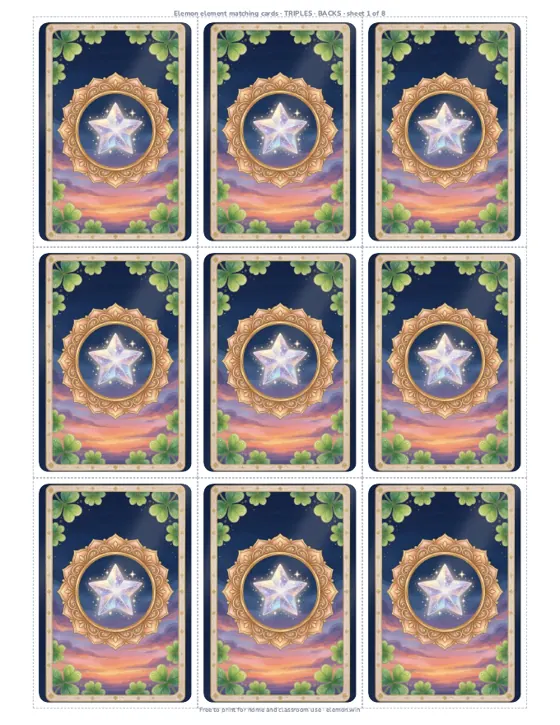
For memory match, yes, or the faces show through face down. Print double-sided and flip on the long edge; every back is the same Elemon card back, so it doesn't matter if a sheet lines up a little off. No duplex printer? Print on card stock and skip the backs, or glue each sheet to a sheet of plain colored paper before you cut.
Why these 24 elements?
They're the first 20, hydrogen to calcium, plus iron, copper, silver and gold. That's the set the Royal Society of Chemistry's bingo game uses, and the four metals give kids the famous odd symbols Fe, Cu, Ag and Au.
More to print: the element scavenger hunt checklist, periodic table bingo, and the element cards 1 to 20 with the real science on the back. Eight games that use them are in easy games to teach kids the element names.
Once the names feel familiar, put them in a battle: play Elemon in your browser.