
 Learn
Types of elements: all 10 families of the periodic table, explained for kids
There are three big types of elements: metals, nonmetals and metalloids. Scientists split those into 10 smaller groups called element families. An element is a pure substance made of just one kind of atom. An atom is a tiny building block, far too small to see. There are 118 elements, and more than three out of four of them are metals.
On this page
Two words first, because the rest of this page leans on them. A "type" here means one of those three big piles: metal, nonmetal, or in between. A "family" means a smaller set of elements that act alike, usually because they share a column on the periodic table, the big chart that puts every element in order. Families sit inside types the way chapters sit inside a book.
My aim isn't to make anyone memorize 10 family names. It's to give you one picture of the table that you can carry around, so that when a new element shows up in a book or a game, you already have a rough idea of where it lives and how it behaves. Call it a neighborhood map. Every section below adds one street to it.
 SodiumBlast · 11
 IronMetal · 26
 SiliconCrystal · 14
 ChlorineAcid · 17
 NeonNoble gas · 10
 UraniumNuclear · 92
All 10 families in one chart
Each row is one family. "Group" means a column on the periodic table, counted 1 to 18 from left to right.
| Element family | Big type | How many | Where on the table | Where you meet it | Best for |
|---|---|---|---|---|---|
| Alkali metals | Metal | 6 | Group 1, far left | Sodium in table salt | The wow factor: they react with water |
| Alkaline earth metals | Metal | 6 | Group 2 | Calcium in your bones | Body and fireworks links |
| Transition metals | Metal | 37 | The wide middle block | Iron, copper, gold | Everyday "metal" things |
| Post-transition metals | Metal | 12 | Just right of the middle | Aluminum foil | Soft metals and cans |
| Metalloids | In between | 7 | Along the zigzag line | Silicon in computer chips | Half metal, half not |
| Reactive nonmetals | Nonmetal | 7 | Top right, plus hydrogen | Oxygen in the air | What living things are made of |
| Halogens | Nonmetal | 6 | Group 17 | Chlorine in pools | The salt-makers |
| Noble gases | Nonmetal | 7 | Group 18, far right | Helium balloons, neon signs | Elements that barely react |
| Lanthanides | Metal | 15 | First row printed underneath | Magnets in earbuds | Magnets and glowing colors |
| Actinides | Metal | 15 | Second row underneath | Smoke detectors | Radioactivity |
Add them up and you get all 118. These counts follow the way most classroom charts sort the table. A few elements on the border, like polonium, get put in a different family on some charts.
Where to start
- Brand new to elements? Learn metals, nonmetals and metalloids first. It's just three groups and one zigzag line.
- Want the most exciting family? Alkali metals. Sodium and potassium fizz and pop when they touch water.
- Want to find elements around your house? Transition metals: iron pans, copper wires, silver and gold jewelry.
- Want the easiest pattern? Noble gases. Every one of them is a gas that almost never reacts.
- Ready for a challenge? Lanthanides and actinides, the two rows printed under the table.
The three big types: metals, nonmetals and metalloids
| Big type | What they're like | Where they sit | Examples |
|---|---|---|---|
| Metals | Shiny. They bend instead of breaking. Heat and electricity move through them easily. All but one are solid at room temperature (mercury is a liquid). | Left side and middle | Iron, Sodium, Aluminum |
| Nonmetals | Most are gases, or solids that crumble. Electricity doesn't move through them well. | Top right, plus hydrogen | Oxygen, Nitrogen, Neon |
| Metalloids | A mix. They can look a bit shiny like metals but act partly like nonmetals. | Right on the zigzag line | Boron, Silicon |
Look for the zigzag line on a periodic table. People also call it the staircase. It starts near boron and steps down to the right.
A trick for spotting metals
The trick: "Metals Left, Nonmetals Right, Metalloids on the Line." Picture the zigzag line as a wall. Everything to the left of the wall is a metal, which is most of the table. Everything to the right is a nonmetal. The few elements standing on the wall are metalloids, because they can't pick a side. There's one rule-breaker: hydrogen sits at the top left, but it's a nonmetal gas.
The 10 element families, one at a time
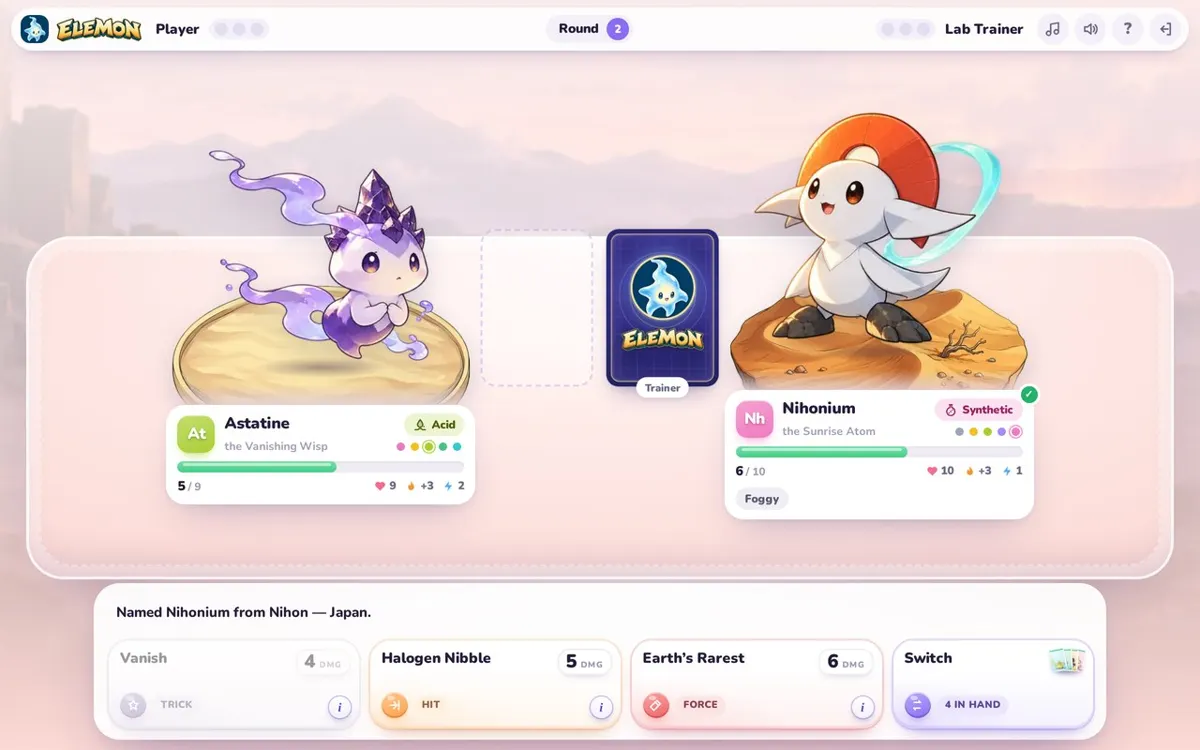
Each family below has fun facts, where you meet it, a clue to spot it, and how it plays in Elemon, the free periodic table card game. In Elemon, every card is a real element, and its type decides who wins a hit. "Beats" means double damage. "Resists" means it only takes half damage. The very heaviest elements, numbers 104 to 118, are made in labs, so the game gives them their own Synthetic type, whatever family they're in.
Alkali metals
Who's in it: lithium, sodium, potassium, rubidium, cesium and francium.
- Surprising facts: They're so soft you could cut sodium with a butter knife. They react with water, and the lower in the column, the wilder it gets. They're so reactive that they're stored under oil to keep air and water away.
- Where you meet them: Sodium is half of table salt. Lithium is in the batteries of phones and tablets. Potassium is in bananas.
- How to spot one: Look in the very first column, under hydrogen.
- Safety: Never touch pure alkali metals, and never put them in water. Leave that to science teachers with safety gear.
- In Elemon: they're Blast type, along with group 2. Blast beats Life, because these metals react hard with water and living things are mostly water. Noble gas beats Blast, and Metal resists it.
Alkaline earth metals
Who's in it: beryllium, magnesium, calcium, strontium, barium and radium.
- Surprising facts: Magnesium burns with a blinding white flame, so it's used in fireworks and sparklers. Strontium makes fireworks red, and barium makes them green. They react with water too, just more calmly than group 1.
- Where you meet them: Calcium builds your bones and teeth, and it's in milk. Magnesium sits in the center of chlorophyll, the green stuff plants use to make food from sunlight.
- How to spot one: Second column from the left.
- Safety: Radium is radioactive. That means it gives off invisible energy that can harm your body. It was once used in glow-in-the-dark watch paint, until people learned it made workers sick.
- In Elemon: also Blast type. Same matchups as the alkali metals.
Transition metals
Who's in it: the big middle block, groups 3 to 12. That includes iron, copper, nickel, silver, gold, platinum, titanium and tungsten.
- Surprising facts: Tungsten has the highest melting point of any metal, over 3,400 °C (RSC). Gold almost never rusts or tarnishes, which is why ancient gold coins still shine. The Statue of Liberty is green because its copper skin reacted with the air over many years (National Park Service).
- Where you meet them: iron in pans, nails and even your blood (it helps carry oxygen). Copper in wires. Nickel in coins. Titanium in some bike frames and airplanes.
- How to spot one: The wide, short middle part of the table.
- In Elemon: they're Metal type. Metal beats Nuclear (thick metal like lead blocks radiation) and beats Crystal. Metal resists Blast. Acid and Rare Earth beat Metal.
Post-transition metals
Who's in it: aluminum, gallium, indium, tin, thallium, lead, bismuth and a few others, sitting just right of the middle block.
- Surprising facts: Gallium melts at about 30 °C, so a piece would melt in your hand (RSC). Aluminum is the most common metal in Earth's crust (USGS). Bismuth can form staircase-shaped crystals that look rainbow-colored, thanks to a very thin coating that forms on the surface.
- Where you meet them: aluminum foil and soda cans. Tin is used as a thin coat on "tin" cans, which are mostly steel.
- How to spot one: Just to the left of the zigzag line, below boron's corner.
- Safety: Lead is poisonous, which is why it was taken out of paint and gasoline.
- In Elemon: also Metal type, with the same matchups as the transition metals.
Metalloids
Who's in it: boron, silicon, germanium, arsenic, antimony and tellurium, plus polonium on some charts.
- Surprising facts: Silicon carries electricity only a little, and that's exactly what makes it perfect for computer chips. Most sand is silicon joined with oxygen. Glass is made from sand.
- Where you meet them: inside every phone, tablet and computer. Boron is part of borax, which some slime recipes use.
- How to spot one: They sit right on the zigzag line.
- Safety: Arsenic is poisonous. Borax shouldn't be eaten, and an adult should help with any borax slime.
- In Elemon: they're Crystal type. Crystal beats Noble gas and resists Acid, a bit like how glass shrugs off most acids. Metal beats Crystal.
Reactive nonmetals
Who's in it: hydrogen, carbon, nitrogen, oxygen, phosphorus, sulfur and selenium.
- Surprising facts: Diamonds and the "lead" in your pencil are both made of pure carbon. The atoms are just arranged differently. Nitrogen makes up about 78% of the air you breathe, and oxygen about 21%. Hydrogen is the most common element in the universe, and it's what powers the Sun.
- Where you meet them: you! Oxygen, carbon, hydrogen and nitrogen make up most of your body. Phosphorus is on the strip of a matchbox. Many stinky smells, like rotten eggs, come from sulfur compounds.
- How to spot one: Top right of the table, plus hydrogen at the top left.
- In Elemon: they're Life type. Life beats Rare Earth, because oxygen tarnishes those metals. Blast and Nuclear beat Life.
Halogens
Who's in it: fluorine, chlorine, bromine, iodine, astatine and tennessine.
- Surprising facts: "Halogen" means "salt-maker." They join with metals to make salts (Britannica). Chlorine plus sodium makes table salt. Bromine is one of only two elements that are liquid at room temperature. The other is mercury.
- Where you meet them: chlorine keeps swimming pools clean. Fluoride, made from fluorine, is in toothpaste and helps protect your teeth. Iodine is added to salt because your body needs a tiny bit.
- How to spot one: Second column from the right, group 17.
- Safety: Pure chlorine is a poisonous gas. Never mix bleach with other cleaners, because it can release dangerous fumes.
- In Elemon: they're Acid type. Acid beats Metal, because halogens eat away at many metals. Crystal and Noble gas resist Acid.
Noble gases
Who's in it: helium, neon, argon, krypton, xenon, radon and oganesson.
- Surprising facts: Their outer layer of electrons is full, so they almost never react with anything (Britannica). Electrons are tiny parts of an atom that zoom around its center. Helium is lighter than air, so balloons float. Breathing it makes voices sound squeaky, but don't try it: it can keep oxygen out of your lungs.
- Where you meet them: helium balloons. Neon signs glow red-orange. Other sign colors usually come from other gases or coatings. Argon is about 1% of the air, and it fills some light bulbs.
- How to spot one: The far right column, group 18.
- Safety: Radon is a radioactive gas that can seep up from the ground, so the EPA suggests testing homes for it, especially basements (EPA).
- In Elemon: they're Noble gas type. Noble gas beats Blast (argon is used to protect reactive metals) and resists Acid. Crystal beats Noble gas.
Lanthanides
Who's in it: the 15 elements from lanthanum to lutetium, in the first row printed under the table. People often call them rare earths, but most aren't actually rare.
- Surprising facts: Neodymium makes the strongest permanent magnets. Europium glows under ultraviolet (black) light and helps protect euro banknotes from fakes (RSC). Cerium is in the "flint" that makes sparks in some lighters.
- Where you meet them: neodymium magnets are inside earbuds, speakers and electric car motors.
- How to spot one: The first of the two separate rows at the bottom.
- In Elemon: they're Rare Earth type. Rare Earth beats Metal, because rare-earth magnets pull hard on iron. Life beats Rare Earth.
Actinides
Who's in it: the 15 elements from actinium to lawrencium, in the second row under the table.
- Surprising facts: Every actinide is radioactive. Most of the ones after uranium are made in labs. Plutonium has powered spacecraft like the Voyager probes and the Curiosity rover on Mars (NASA).
- Where you meet them: ionization smoke detectors use a tiny amount of americium (EPA). Uranium is fuel for nuclear power plants.
- How to spot one: The very bottom row.
- Safety: Radioactive materials should only be handled by trained experts. The bit in a smoke detector is sealed inside, so leave it closed.
- In Elemon: they're Nuclear type. Nuclear beats Life, because radiation damages living cells. Metal beats Nuclear.
Why a whole column acts alike
Elements in the same column have the same number of electrons in their outer layer. Those outer electrons decide how an element acts. That's why a whole column can share a personality. (Families of people work the same way, minus the electrons.) Every alkali metal has one outer electron it gives away easily, so they're all super reactive. Every noble gas has a full outer layer, so they're all calm. Want the basics of rows and columns? Read what is the periodic table.
The families in Elemon
In Elemon, every card is a real element, and its color is its type. That turns the periodic table into colored zones you can see at a glance. Here's the Elemondex, where you can sort all 118 cards by type:
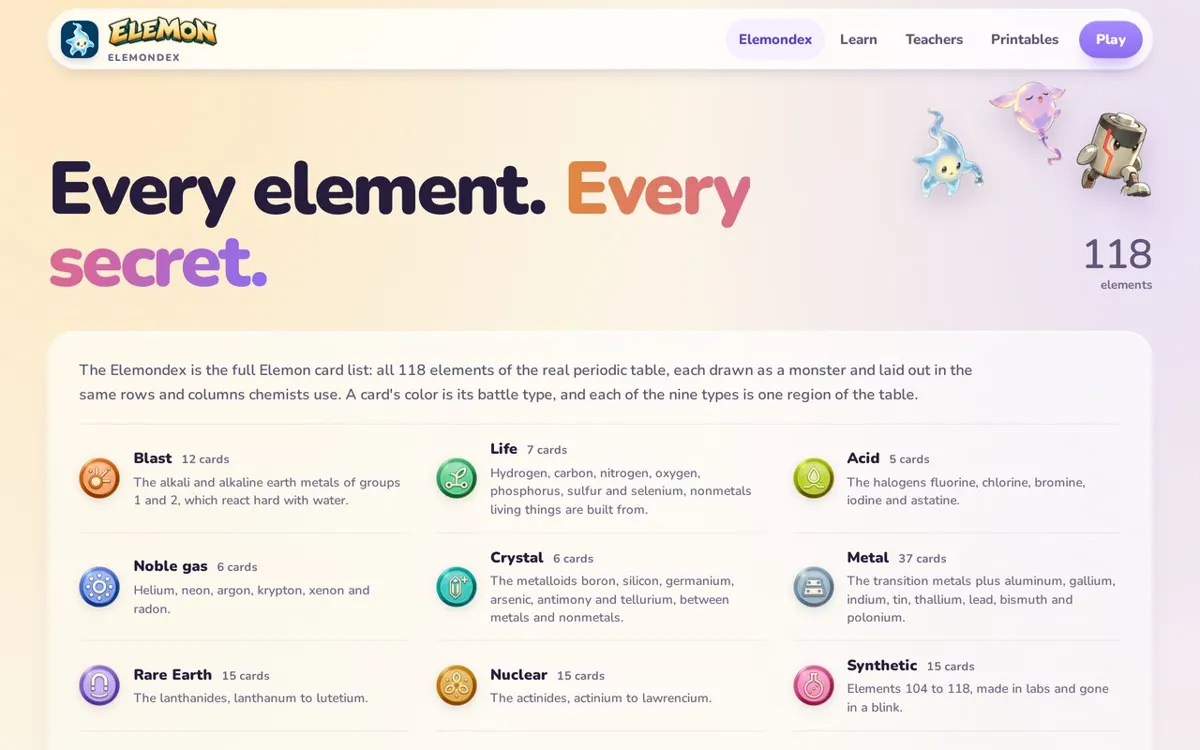
- Blast 12
- Life 7
- Acid 5
- Noble gas 6
- Crystal 6
- Metal 37
- Rare Earth 15
- Nuclear 15
- Synthetic 15
The game folds the 10 families into nine battle types. The full list, plus which matchups are real science and which are just game rules, is in Elemon's types vs. the real element families.
A safe element hunt at home
You don't need any chemicals for this, just your eyes. Grab a notebook and look for these:
- Aluminum: foil or a soda can. Is it shiny? Does it bend? Those are metal clues.
- Iron: a pan or a paperclip (paperclips are steel, which is mostly iron). Hold a fridge magnet near it. Iron sticks to magnets!
- Copper: look at a penny. Pennies made since 1982 are 97.5% zinc with a thin copper coating (US Mint).
- Sodium and chlorine: the salt shaker. Two dangerous elements joined together make something you sprinkle on food.
- Carbon: the tip of a pencil.
For each one, write its family and whether it's a metal, nonmetal or metalloid. Now try the magnet on the aluminum can. It won't stick, which shows that not every metal is magnetic.
Mini quiz
Try these, then check your answers below.
- Which family is in the far right column?
- What are the three big types of elements?
- Your bones are full of which alkaline earth metal?
- Which metalloid is in computer chips?
- Diamonds and pencil "lead" are made of which element?
- In Elemon, which type beats Metal for double damage?
Show the answers
- The noble gases.
- Metals, nonmetals and metalloids.
- Calcium.
- Silicon.
- Carbon.
- Acid (the halogens). Rare Earth beats Metal too.
Glossary
- Atom: the tiny building block of everything. Each element has its own kind.
- Element: a pure substance made of only one kind of atom. There are 118.
- Compound: two or more elements joined together, like salt (sodium + chlorine). See elements vs. compounds.
- Electron: a tiny part of an atom that moves around its center. The outer ones decide how an element reacts.
- Family: a set of elements that act alike, usually in the same column.
- Group: a column on the periodic table, numbered 1 to 18.
- Period: a row on the periodic table.
- React: when elements join or swap partners and make something new.
- Radioactive: gives off invisible energy that can harm living things.
- Zigzag line: the staircase line that splits metals from nonmetals.
Frequently asked questions
How many types of elements are there?
There are three big types: metals, nonmetals and metalloids. Scientists split them into 10 families: alkali metals, alkaline earth metals, transition metals, post-transition metals, metalloids, reactive nonmetals, halogens, noble gases, lanthanides and actinides.
What are the 3 main types of elements?
Metals, nonmetals and metalloids. Metals are on the left and in the middle. Nonmetals are at the top right. Metalloids sit on the zigzag line between them.
Which type of element is most common on the periodic table?
Metals. More than 90 of the 118 elements are metals. The transition metals alone are 37.
Is hydrogen a metal?
No. Hydrogen sits at the top of the first column, but it's a nonmetal gas. It's placed there because it has one outer electron, just like the alkali metals.
What's the difference between a family and a group?
A group is just a column number, from 1 to 18. A family is a name for elements that act alike. For groups 1, 2, 17 and 18, they're the same thing. The transition metals cover 10 columns at once.
Which elements are liquid at room temperature?
Only two: mercury, a metal, and bromine, a halogen.
That's the neighborhood map, all of it. If you'd rather learn it without a worksheet, play a free match of Elemon. Every card is a real element, and its type decides who wins.